Every Christmas, My Father Mailed Me a Blank Card. After He Passed Away, I Learned They Were Never Blank.
The first Christmas card from my father arrived two years after we stopped speaking.
By then, I had settled into a small apartment in Chicago, where I spent long days working as a junior architect and even longer nights trying to convince myself that leaving home had been worth the price. Christmas had become a quiet affair. My wife, Anna, and I had only recently married, and money was tight enough that our decorations consisted of a second-hand tree, a string of mismatched lights, and a star made from folded cardboard.
One evening, after returning from work, I sorted through the usual pile of mail on the kitchen counter. Utility bills. A supermarket flyer. A magazine neither of us remembered subscribing to. Then I noticed a cream-colored envelope with my name written in a familiar hand.
I hadn’t seen that handwriting in nearly two years.
It belonged to my father.
For a long moment, I simply stood there with the envelope in my hands. Anna looked up from the sofa where she was wrapping presents and smiled.
“Good news?”
“I’m not sure.”
I carefully opened the envelope.
Inside was a simple Christmas card. No elaborate design, no family photograph, nothing that suggested much thought had gone into choosing it. I opened it expecting, at the very least, a signature.
There was nothing.
The inside of the card was completely blank.
I turned it over, checking whether something had been tucked inside.
Nothing.
Anna set down the roll of wrapping paper and walked over.
“What does he say?”
I handed her the card without answering.
She examined both pages before looking back at me with a puzzled expression.
“There’s no message.”
“I noticed.”
“Maybe he forgot?”
I couldn’t help smiling.
“My father doesn’t forget things.”
She hesitated, choosing her words carefully.
“Then why send a blank card?”
“I wish I knew.”
I slid it back into the envelope and left it on the counter for a few days before eventually throwing it away. It seemed too strange to keep, yet too personal to discard immediately. In the end, curiosity gave way to practicality, and life moved on.
The following December, another card arrived.
Same cream-colored envelope.
Same neat handwriting.
Same blank interior.
By the third year, the ritual had become strangely familiar. Every Christmas, sometime during the second week of December, I would find another envelope from my father waiting in the mailbox. Every year I would open it hoping, against my better judgment, that there might finally be a sentence inside.
There never was.
Eventually, even hope disappeared.
Opening the card became little more than a habit. I would glance inside, confirm it was empty, and drop it into the recycling bin before getting on with my day.
Anna never stopped wondering.
“Maybe he’s trying to reach out,” she suggested one year as she watched me throw another card away.
“By saying nothing?”
“Maybe he doesn’t know what to say.”
I leaned against the kitchen counter.
“He knew exactly what to say twenty-five years ago.”
She didn’t answer.
She knew the story.
Everyone close to me did.
When I was growing up, my father wasn’t an unkind man.
He was quiet, disciplined, and believed almost everything worth learning could be taught with your hands rather than your words. Saturday mornings were spent repairing broken fences, changing the oil in the truck, or helping customers at the family hardware store. If I wanted to spend time with him, I picked up a hammer or a broom.
Looking back, I realise those ordinary days were his way of saying he loved me.
He simply belonged to a generation of men who rarely spoke those words aloud.
By the time I graduated from university, however, we wanted very different futures.
My father expected me to inherit the hardware store, just as he had inherited it from my grandfather. In his mind, the path had already been laid. The business would remain in the family, and I would continue what three generations had built.
I had other plans.
Architecture had fascinated me since childhood. I wanted to design schools, libraries, and public buildings that might stand for generations. When a respected firm in Chicago offered me my first job, accepting it felt like the beginning of the life I’d worked toward for years.
To my father, it felt like betrayal.
“I don’t understand,” he said the evening I told him. We were standing in the stockroom after closing, surrounded by shelves of paint cans and power tools. “You’ve got a business waiting for you. Why throw that away?”
“I’m not throwing anything away.”
“You’re walking away from your family.”
“I’m taking a job.”
“Somewhere five hundred miles from home.”
“I’ve spent four years studying for this.”
“And what was wrong with what you already had?”
I remember taking a long breath before answering.
“Nothing… if it had been your dream.”
His face hardened.
“It isn’t?”
“No.”
The silence that followed stretched between us like a wall being built brick by brick.
When I left for Chicago three weeks later, my mother hugged me until I could barely breathe.
My father shook my hand.
Neither of us realised that it would be the last real conversation we would have for more than twenty-five years.
For the first few months after I moved to Chicago, my mother tried to keep the peace.
She called every Sunday evening, usually while preparing dinner. I could hear pots clattering in the background and my father answering customers’ questions whenever someone wandered into the hardware store just before closing.
“He asks about you,” she would say.
“What does he ask?”
“If you’re eating properly.”
I smiled despite myself.
“And?”
“I tell him you’re working too hard.”
“He could always call.”
A pause would follow.
“You know your father.”
I did.
Too well.
He wasn’t cruel.
He wasn’t stubborn for the sake of winning.
He simply belonged to a generation that believed love was demonstrated through responsibility, not conversation. Apologies were unnecessary if you had provided for your family. Feelings were private. Pride wasn’t considered a flaw; it was considered dignity.
The trouble was, I’d inherited more of that pride than either of us cared to admit.
The years slipped by more quickly than I expected.
Anna and I bought our first home, a modest brick house with squeaky floorboards and a backyard barely large enough for a vegetable garden. We welcomed our first child, a daughter we named Lily, and three years later our son, Ben, arrived with the same dark hair I’d inherited from my father.
Life became wonderfully ordinary.
School runs.
Soccer practice.
Parent-teacher meetings.
Late nights finishing architectural drawings while Anna graded papers at the dining table.
Somewhere in the middle of all that, another Christmas card would appear.
Always during the second week of December.
Always addressed in the same careful handwriting.
Always blank.
The cards became so predictable that Lily eventually noticed them.
She couldn’t have been more than eight the first time she asked.
“Who’s this one from?”
“My dad.”
She opened the card before I could stop her.
“There’s nothing inside.”
“I know.”
She looked genuinely confused.
“Then why does Grandpa send it?”
“I’ve wondered the same thing.”
She thought about it for a moment.
“Maybe he doesn’t know what to write.”
Children have a remarkable way of offering explanations adults overlook.
I wanted to believe she was right.
But I knew my father.
He chose his words carefully.
Silence, too, was always a choice.
My mother visited whenever she could.
She adored the grandchildren and somehow managed to make our little house feel fuller the moment she walked through the front door.
She always brought homemade cookies.
She always left with empty containers because Anna insisted on sending leftovers home with her.
She never arrived without carrying news from back home.
“Your father’s finally replacing the roof.”
“Business has been slower this year.”
“He’s teaching a young fellow how to repair old window frames.”
Occasionally I’d ask, almost without thinking,
“How’s he doing?”
She always answered honestly.
“He’s getting older.”
Then, after a pause, she’d add,
“So are we.”
There were moments when I came close to asking for his phone number.
Not because I didn’t know it.
Because dialing it felt like admitting I had been wrong.
Every time the thought crossed my mind, another followed immediately behind it.
If he wanted to talk, he’d call.
I suspect my father was thinking exactly the same thing.
When my mother was diagnosed with pancreatic cancer, every argument I’d ever had with either of my parents suddenly felt insignificant.
Anna and I drove home almost every weekend.
The hospital was forty minutes from the old family house, and after each visit I’d drive my father home in near silence.
We spoke about practical things.
Medication.
Insurance paperwork.
Whether the driveway needed salting before the next snowfall.
Never about us.
Never about the years we’d lost.
One evening, after dropping him off, he rested his hand on the truck door before climbing out.
“You’ve done well.”
I looked at him.
“What do you mean?”
“The buildings.”
I frowned.
“What buildings?”
“I saw an article.”
It took me a second to understand.
A local newspaper had run a feature about a public library my firm had designed.
I hadn’t realized anyone back home had seen it.
He nodded once.
“It looked… good.”
It was the closest thing to a compliment he’d given me since I was a teenager.
I wanted to say something.
Anything.
Instead, I simply replied,
“Thanks.”
He climbed out of the truck.
That was the last conversation we had before my mother died.
Grief changes the shape of a family.
After the funeral, relatives drifted back to their own lives, but the house felt impossibly large with only one person living in it.
I called my father twice during the following year.
Both conversations lasted less than five minutes.
Neither of us mentioned the past.
Neither of us knew how.
Yet every December, another blank Christmas card arrived.
Anna would place it beside my dinner plate with the rest of the mail.
I would open it.
Look inside.
Find nothing.
And quietly wonder whether the silence between us had become so familiar that neither of us remembered how it had started.
Three years passed before I saw my father again.
It wasn’t Christmas that brought us together.
It was another funeral.
My aunt Margaret, my mother’s older sister, had passed away after a long battle with Alzheimer’s. The service was held in the same little church where I had been married and where we had buried my mother only a few years earlier.
My father was already seated when Anna and I arrived.
Age had caught up with him.
His shoulders seemed narrower than I remembered, and the thick dark hair that had survived most of his life had finally surrendered to gray. He looked smaller somehow, as though grief had quietly worn away pieces of him that time alone could never have reached.
After the service, relatives gathered outside beneath the church steps.
People talked about Margaret’s kindness, her terrible singing voice, and the apple pies she insisted were never quite good enough.
Dad stood alone near the parking lot.
For several minutes I watched him from a distance, wondering whether I should walk over.
Before I could decide, he started toward me.
“You’ve got more gray hair than I do now,” he said.
I laughed.
“I’ve earned every one of them.”
He nodded.
“So have I.”
For a moment, it almost felt normal.
Then someone called his name from across the parking lot, and the moment disappeared as quickly as it had come.
He gave me a small nod before walking away.
Neither of us realized it would be the last time we would ever see each other.
The following Christmas, another blank card arrived.
Anna found me staring at it in the kitchen.
“You haven’t opened it.”
“I know.”
“Are you afraid this year it won’t be blank?”
I looked at her.
“I think I’m afraid it will be.”
I opened it anyway.
Blank.
Exactly like every year before.
I smiled sadly.
“He’s nothing if not consistent.”
Anna slipped her arm through mine.
“You know…”
“What?”
“Sometimes people say the wrong thing because they don’t know how to say the right one.”
I looked down at the empty card.
“I’ve spent twenty-five years trying to decide whether this means nothing…”
“…or everything.”
Three months later, my sister called just after sunrise.
The moment I heard her voice, I knew.
“Dad passed away last night.”
I closed my eyes.
Even after everything…
Even after twenty-six years of silence…
The words hurt more than I expected.
“When?”
“Around midnight.”
“Was anyone with him?”
She hesitated.
“I was.”
That mattered.
I was grateful he hadn’t been alone.
The funeral was quiet.
Most of the faces belonged to retired customers from the hardware store or neighbors who had known my parents for decades.
One by one, they shared stories I’d never heard.
How Dad quietly repaired a widow’s broken porch without charging her.
How he kept a notebook of customers who were struggling and let them pay months later without ever mentioning it again.
How every Christmas Eve he delivered firewood to three elderly couples before going home himself.
Listening to them, I realized something that unsettled me.
I had spent years remembering my father through the worst conversation we’d ever had.
They remembered him through hundreds of small acts of kindness.
Neither version was false.
But neither was complete.
After the service, while everyone else made their way toward the cemetery, I stayed behind outside the church.
The March wind carried the smell of rain.
That’s when an elderly man in a faded postal jacket approached me.
His name badge read:
Walter Greene.
“I’ve been looking for you.”
“I’m sorry… have we met?”
He smiled.
“I delivered your father’s mail for nearly thirty years.”
He offered his hand.
“I also delivered every Christmas card he ever sent you.”
I felt my stomach tighten.
“You knew about those?”
Walter chuckled softly.
“Oh, I knew more about those cards than anyone.”
He looked at me for a long moment before asking a question so unexpected that I almost thought I’d misheard him.
“Did you ever warm the cards before opening them?”
For a moment, I simply stared at him.
“I’m sorry?”
Walter nodded toward the church doors as though the answer should have been obvious.
“The cards.”
He spoke gently, almost apologetically.
“Did you ever warm them before opening them?”
I shook my head.
“No.”
“Why would I?”
He slipped his hands into the pockets of his old postal jacket.
“Because your father bought a special fountain pen about twenty-six years ago.”
I frowned.
“A fountain pen?”
“Not an ordinary one.”
Walter smiled faintly.
“It was designed for invisible ink.”
I felt my pulse quicken.
“You’re telling me the cards weren’t blank?”
“They looked blank.”
He paused.
“But they weren’t.”
For several seconds, neither of us spoke.
I searched his face, looking for some hint that this was a joke.
There wasn’t one.
“My father wrote messages?”
“Every single year.”
The world suddenly felt strangely unsteady.
“I threw them away.”
Walter nodded sadly.
“I know.”
“You knew?”
“He asked me once if you’d ever mentioned the cards.”
“And?”
“I told him no.”
I swallowed hard.
“What did he say?”
Walter looked toward the cemetery where the funeral procession had already begun.
“He smiled.”
“‘Then he’s still opening them,’ he said.”
I closed my eyes.
Even after twenty-six years…
Dad had found comfort in knowing I still opened the envelopes.
“He never asked whether you’d read the messages.”
“Only whether you’d opened the cards.”
“I don’t understand.”
Walter reached into the inside pocket of his jacket.
“I hoped you might say that.”
He carefully removed a cream-colored envelope.
My name was written across the front.
In my father’s handwriting.
I stared at it.
“It’s postmarked last week.”
“He mailed it four days before he died.”
My hands shook as I accepted it.
“It’s the last one.”
Walter nodded.
“He asked me to make sure you received it.”
I looked at the envelope for a long moment.
“I don’t have a heater.”
“You don’t need one.”
He smiled.
“A hair dryer works.”
That evening, I sat alone at the dining room table.
Anna quietly placed a hair dryer beside me without saying a word.
“I’ll be upstairs.”
I nodded.
The house fell silent.
I opened the envelope.
Inside was another ordinary Christmas card.
Blank.
Just like every year before.
I almost laughed.
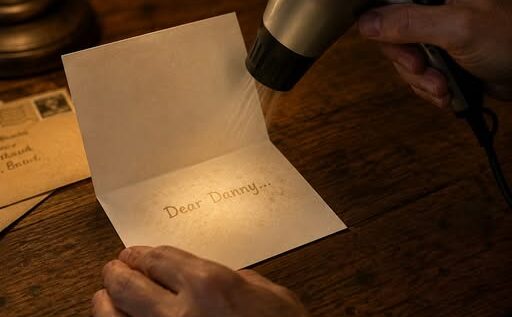
Then I plugged in the hair dryer.
Holding it several inches above the paper, I slowly moved the warm air across the inside of the card.
Nothing happened.
For a few seconds.
Then…
Faint brown lines began appearing across the page.
My heart started pounding.
Letter by letter…
Sentence by sentence…
My father’s handwriting slowly emerged from what I had believed was empty paper for more than a quarter of a century.
I couldn’t stop staring.
The first line read:
Dear Danny…
No one had called me Danny since I left home.
Tears blurred my vision before I’d even reached the second sentence.
Dear Danny,
I don’t know whether you’ll ever read this.
Maybe you’ll think the cards are empty. Maybe you’ll never discover how to find the words.
If that’s what happens, I suppose that’s my fault. I’ve never been very good at saying important things out loud.
I stopped reading.
That sounded exactly like him.
Plain.
Honest.
Painfully honest.
I wiped my eyes and continued.
Every year I write another card because every year I hope next Christmas might be different.
Not because I expect you to come home.
Just because I want you to know there’s still a place for you if you ever decide to.
The words shook me.
For twenty-six years…
He’d been writing.
Every Christmas.
The hardware store closed today.
I thought you should know.
It deserved better than the two of us giving each other the silent treatment.
I smiled sadly.
The old store had been part of our family for nearly eighty years.
Neither of us had been there when the doors finally closed.
The final paragraph was shorter.
The handwriting looked slightly less steady than the rest.
I’ve spent too many years believing fathers are supposed to wait for sons to come back.
Maybe that’s pride.
Maybe it’s fear.
I don’t know anymore.
What I do know is this.
I was proud of you the day you became an architect.
I was just too foolish to tell you.
Merry Christmas, son.
Love, Dad.
The room disappeared behind tears I could no longer hold back.
For twenty-six years…
I’d believed my father had mailed me nothing.
The truth was far harder to accept.
He had mailed me everything he never found the courage to say.
I don’t remember how long I sat there.
By the time Anna came downstairs, the hair dryer had long since gone cold, and the Christmas card lay open on the table in front of me. My face must have said everything because she didn’t ask what had happened. She simply pulled out the chair beside me and waited.
Without a word, I handed her the card.
She read it slowly.
By the time she reached the last line, tears had gathered in her eyes.
“He loved you,” she whispered.
“I know.”
The words surprised me as much as they surprised her.
For years, I had convinced myself that my father had chosen silence because he didn’t care enough to bridge the distance between us. Sitting there with that card in my hands, I realized the silence had never been empty.
It had simply been hidden.
Just like the words.
The following week, Walter called.
“I’ve been meaning to give you something,” he said. “Would you mind stopping by?”
The old post office had long since closed, but Walter still lived in the small brick house behind it. When I arrived, he disappeared into a spare bedroom and returned carrying a weathered cardboard box tied with faded twine.
“I think these belong to you.”
He placed the box on the dining room table.
Inside were Christmas cards.
Dozens of them.
I recognized the cream-colored envelopes immediately.
My father’s handwriting covered every one.
I looked up, confused.
“I threw these away.”
Walter nodded.
“I know.”
“Then how…?”
He settled into the chair opposite me.
“Your father asked me a favor the second Christmas after you moved away.”
“What kind of favor?”
“He said, ‘If my boy ever throws these cards away before reading them, would you keep them for me?'”
I frowned.
“He thought I’d throw them away?”
Walter smiled sadly.
“No.”
“He thought you might never discover how to read them.”
The room fell silent.
“He knew?”
“He wasn’t certain,” Walter replied. “But he suspected. Every year he’d ask whether you were still opening the envelopes.”
“And every year I’d tell him yes.”
I looked down at the stack of cards.
“So he knew I wasn’t reading the messages.”
Walter gave a slow nod.
“He once told me, ‘Maybe one Christmas he’ll figure it out. Until then, I’d rather the words have somewhere to wait.'”
I couldn’t speak.
For more than two decades, my father had never stopped writing.
And when he realized those words might never reach me, he quietly made sure they wouldn’t be lost forever.
That evening, Anna and I sat at the dining room table long after sunset.
One by one, we warmed the cards.
One by one, hidden words slowly appeared.
Some messages were ordinary.
The apple tree finally produced enough fruit for your mother’s pies this year.
Others made me laugh through my tears.
I attempted your mother’s lasagna tonight. We agreed pizza was the wiser decision.
Some spoke proudly about my children.
Your mother keeps every school photograph you send. She says Lily has your smile, and Ben asks as many questions as you did.
Every Christmas had left another piece of my father’s heart waiting inside those folded cards.
And every single one ended exactly the same way.
Merry Christmas, son. Love, Dad.
Not once did he forget to write those words.