My Brother Missed Every Family Reunion for Fifteen Years. At Our Mother’s Funeral, He Handed Me a Key
For fifteen years, my older brother Daniel existed in our lives like a name carved into an old photograph—always present, yet somehow unreachable. Every Christmas, my mother set an extra place at the dinner table before quietly removing it again. Every Thanksgiving, she insisted on making Daniel’s favorite sweet potato casserole even though no one else cared for it. On birthdays, anniversaries, and family reunions, she always paused before serving dessert, glanced toward the front door, and smiled as if she genuinely believed she might hear his familiar knock.
It never came.
The rest of us stopped expecting him long before she did.
No one could say exactly when Daniel disappeared. There hadn’t been a dramatic argument or a public falling-out. He simply stopped coming home. At first, he claimed work kept him busy. Then business trips became more frequent. After that came brief phone calls, Christmas flowers delivered by strangers, birthday cards with no return address, and occasional envelopes containing money whenever Mom insisted she didn’t need it.
He was never completely gone.
He was just never there.
Dad took it personally.
“If he can send money,” he’d grumble every December, “he can buy a plane ticket.”
Mom would gently place a hand on his arm before the conversation turned into another evening of resentment.
“You don’t know what he’s carrying.”
Dad always had the same answer.
“I know exactly what he’s carrying.”
He’d glance toward the empty chair.
“Himself.”
As the years passed, the empty chair became part of the family. New nieces and nephews grew old enough to ask who it belonged to. We answered with stories about an uncle they barely remembered—how he’d once built treehouses from scrap timber, how he’d taught me to ride a bicycle without training wheels, how he could fix almost anything with a roll of duct tape and enough patience.
To the younger children, he sounded less like a real person and more like a character from one of Grandpa’s old stories.
Sometimes I wondered if that was becoming true for me as well.
When Dad died, I truly believed Daniel would come home.
He didn’t.
Instead, a wreath arrived with a small handwritten card.
For Dad. I’m sorry.
That was all.
I stood beside our father’s grave with anger burning hotter than grief.
Mom, somehow, remained calm.
“One day,” she whispered as we walked back toward the church, “you’ll understand.”
I hated those words.
Not because they were cruel.
Because they were hopeful.
Hope had become exhausting.
Over the following seven years, Mom grew older in the quiet, predictable ways that seem harmless until suddenly they aren’t. She forgot where she’d left her glasses, even when they were resting on her head. She laughed about needing brighter light to read recipes she’d known by heart for decades. Her hands trembled slightly whenever she poured tea, and she began calling me to change light bulbs she could once have reached without thinking.
She never stopped defending Daniel.
Whenever relatives criticized him, she changed the subject.
Whenever someone suggested he should be ashamed of staying away, she’d simply smile.
“You don’t know everything.”
One afternoon, while helping her clear out the attic, I finally lost my patience.
“What don’t we know?”
She folded an old quilt before answering.
“I made him promise.”
I stared at her.
“Promise what?”
She looked at me with the same gentle expression she’d worn my entire life.
“I can’t tell you.”
I laughed in disbelief.
“So you actually know why he disappeared?”
“I know enough.”
“And you’ve let everyone believe he abandoned us?”
She didn’t answer immediately.
Instead, she placed another box beside the attic window and brushed a layer of dust from its lid.
“Sometimes protecting one child hurts another.”
It wasn’t an answer.
It was another mystery.
I drove home more frustrated than ever.
Anna listened quietly as I told her about the conversation.
“You think she’s covering for him?”
“I know she is.”
“Why?”
“I don’t know.”
She stirred her tea thoughtfully.
“Maybe because she promised him.”
I looked at her.
“You sound just like my mother.”
Anna smiled.
“I’ve always liked her.”
Mom passed away peacefully in her sleep three winters later.
She was eighty-one.
The doctor called it heart failure.
I called it loneliness.
The church was full on the morning of her funeral. Friends from the neighborhood, former coworkers, cousins I hadn’t seen in years, and people whose names I barely remembered all came to say goodbye to the woman who had somehow remembered everyone’s birthday without ever writing them down.
As I stood near the front greeting mourners, I caught myself glancing toward the entrance every few minutes.
I wasn’t expecting Daniel.
I was hoping to prove myself right.
The service ended.
People began filing outside.
I almost relaxed.
Then the church doors opened one final time.
Daniel walked in.
For a second, I didn’t recognize him.
The confident young man who had left fifteen years earlier had been replaced by someone leaner, older, and visibly tired. His hair had turned almost completely gray at the temples, and deep lines framed his eyes. He wasn’t frail, but he carried himself like someone who had spent years sleeping lightly, always prepared to leave at a moment’s notice.
Conversations around the room faded.
People noticed him immediately.
He acknowledged no one.
Not our cousins.
Not old family friends.
Not even the pastor.
He walked straight toward me.
For a moment we simply looked at one another.
Fifteen years disappeared into that silence.
“I’m sorry,” he said quietly.
His voice sounded exactly the same.
Older…
But unmistakably Daniel.
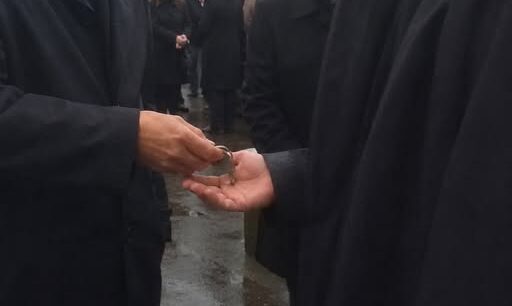
Before I could answer, he placed something cold into my palm.
It was an old brass key attached to a faded leather tag.
Written across the tag, in my mother’s unmistakable handwriting, were four words.
Box 214. County Bank.
I looked up.
“What is this?”
“It belonged to Mom.”
“A safety deposit box?”
He nodded.
I frowned.
“Why are you giving it to me?”
“Because she wanted you to open it.”
“And you?”
A faint smile crossed his face.
“I’ve already seen what’s inside.”
My chest tightened.
“You knew about this?”
“For years.”
I stared at him.
“Then tell me.”
He slowly shook his head.
“I can’t.”
“Daniel…”
His eyes met mine.
“Don’t judge me until you’ve opened what it unlocks.”
Before I could ask another question, he turned and walked toward the exit.
“That’s it?”
He stopped with one hand on the church door.
“Mom was right.”
“About what?”
“One day…”
He looked back at me.
“…you’d understand.”
Then he walked away.
The bank manager recognized the key immediately.
“Mrs. Carter instructed us to release the contents to either of her sons after her passing.”
He unlocked a narrow steel box and placed it on a private viewing table before quietly leaving the room.
Inside wasn’t money.
There were no deeds, jewelry, or family heirlooms.
Only three things.
A sealed envelope.
An old cassette tape.
And a worn leather journal.
The envelope was addressed to both of us.
For Daniel and Michael. Read this first.
My hands trembled as I unfolded the letter.
My dear boys,
If you’re reading this, then I’m finally gone, and Daniel has done exactly what he promised me he would do. Before either of you become angry with him, you deserve to know something I should have told you years ago. I simply couldn’t bear to while I was alive.
I stopped.
Already, the knot of resentment I’d carried for fifteen years began to loosen.
Sixteen years ago, your brother came to me after receiving a medical diagnosis. The doctors believed he had an inherited neurological condition. At the time, they couldn’t tell us how quickly it might progress or whether he would eventually lose the ability to care for himself.
I stared at the page.
Daniel…
Sick?
He begged me not to tell anyone until he knew for certain. He said he couldn’t bear watching the family spend years worrying over something that might never happen.
I read on.
When your father became ill shortly afterward, Daniel made another decision. He chose to keep his distance because he believed your father deserved peace rather than another burden. I argued with him for weeks. I cried. I pleaded. In the end, I made him promise only one thing—that one day, after I was gone, he would tell you everything.
The room blurred.
For fifteen years I’d believed my brother had abandoned us.
In reality…
He had been disappearing because he thought he was protecting us.
I reached for the cassette tape.
Attached to it was another note.
Your brother insisted on recording this himself. Please listen together if you can.
I closed my eyes.
For the first time in fifteen years…
I picked up my phone and called Daniel.
Daniel answered on the second ring.
For a moment, neither of us spoke.
Fifteen years of distance has a way of making even the simplest greeting feel unfamiliar.
Finally, I cleared my throat.
“I opened the safety deposit box.”
“I figured you would.”
“I read Mom’s letter.”
A long silence followed.
Then he asked quietly,
“Do you hate me?”
The question caught me completely off guard.
“No.”
“I’ve spent fifteen years thinking you probably should.”
I closed my eyes.
“I don’t understand everything yet.”
“You deserve to.”
He took a slow breath.
“I’m coming over.”
He arrived just after sunset.
When I opened the door, we stood facing each other awkwardly, neither of us quite knowing whether brothers who had lost fifteen years were supposed to shake hands or hug.
In the end, Daniel made the decision for both of us.
He stepped forward and wrapped his arms around me.
Neither of us let go for a long time.
Anna quietly placed two cups of coffee on the dining table before disappearing upstairs, giving us the privacy we both needed.
The cassette recorder had belonged to our father.
It still worked.
I pressed the play button.
For a second there was only the soft hiss of old tape.
Then our mother’s voice filled the room.
Older.
Gentler.
Exactly as I remembered it.
“My boys…”
Daniel lowered his head.
“If you’re listening to this together,” she continued, “then one of my greatest prayers has finally been answered.”
I felt my throat tighten.
“I know both of you have spent years believing the other made a choice.”
She paused.
“The truth is… both of you were trying to protect someone you loved.”
I looked across the table.
Daniel’s eyes remained fixed on the tape recorder.
“When Daniel received his diagnosis, the specialists believed he had inherited a neurological disease that would gradually take away his independence. They couldn’t promise how quickly it would happen. They couldn’t even promise he would live to see old age.”
Daniel finally spoke.
“I was terrified.”
His voice barely rose above a whisper.
“I watched Dad taking care of Grandpa during his last years. I couldn’t bear the thought of everyone watching me disappear the same way.”
“So you left?”
He nodded.
“I told myself it would be easier if everyone slowly got used to life without me.”
I couldn’t believe what I was hearing.
“You thought disappearing would hurt less than staying?”
“I thought it would spare all of you.”
He laughed bitterly.
“I wasn’t very good at making decisions back then.”
Mom’s voice continued.
“I begged him not to leave. We argued for weeks. Eventually, I asked him to promise me three things.”
Daniel smiled sadly.
“I remember.”
“First,” Mom said on the recording, “he would let me know where he was every month.”
“I did.”
“Second, he would never stop reminding his family that he loved them, even if he couldn’t be with them.”
I looked up.
“The flowers.”
Daniel nodded.
“The birthday cards.”
“The money whenever something broke around the house.”
He smiled faintly.
“Mom always found a reason to accept it.”
The third promise came last.
“And finally… when my time came, he would come home and tell his brother everything.”
The tape clicked softly as it reached the end.
Neither of us moved.
After several minutes, I asked the question that had been sitting in my mind since reading Mom’s letter.
“What happened?”
Daniel looked confused.
“The illness.”
He let out a long breath.
“The doctors were wrong.”
I blinked.
“What?”
“They found the mistake almost three years later.”
He gave a weary smile.
“The blood samples had been mixed up during genetic testing.”
I stared at him in disbelief.
“You were healthy?”
“I always had been.”
I pushed my chair back.
“Then why didn’t you come home?”
He looked down at his hands.
“How?”
“What do you mean?”
“I’d already missed birthdays.”
“Christmas.”
“Dad’s retirement.”
“I’d convinced myself everyone hated me.”
He looked up, his eyes filled with regret.
“The longer I stayed away… the harder it became to explain.”
I understood that feeling better than I wanted to admit.
Pride has a way of convincing us that tomorrow will always be easier.
Until twenty tomorrows have passed.
Daniel reached into his coat and placed the worn leather journal on the table.
“I kept this because I couldn’t say any of it out loud.”
I opened it.
The first entry was dated fifteen years earlier.
Today I drove away from home. Mom cried. Michael looked confused. Dad looked disappointed. I told myself they’d be better off remembering me healthy. I don’t know if I’m brave or just afraid.
The pages that followed chronicled an ordinary life lived under extraordinary fear.
Medical appointments.
Sleepless nights.
The relief of learning the diagnosis had been wrong.
Then page after page of indecision.
It’s been four years now. How do you apologize for four years?
Five years later:
Now it’s nine.
Another Christmas:
Maybe next year.
I closed the journal.
“So all this time…”
“I wanted to come home.”
“You could have.”
“I know.”
He smiled sadly.
“I just forgot that forgiveness usually begins with showing up.”
The following Sunday, we drove to our parents’ graves together.
Neither of us spoke much.
We didn’t need to.
Daniel placed fresh flowers beside Mom’s headstone.
I knelt beside Dad’s.
“I think they knew we’d figure it out eventually,” I said.
Daniel nodded.
“Mom definitely did.”
Before we left, he looked at me.
“I can’t give you back fifteen years.”
“I know.”
“But if you’ll let me…”
He hesitated.
“I’d like to come to Christmas this year.”
I smiled for what felt like the first time in days.
“You’d better.”
“Why?”
“Lily still thinks you’re the uncle who builds treehouses.”
He laughed.
“I might be a little rusty.”
“That’s alright.”
“So are we.”
That Christmas, for the first time in fifteen years, my mother didn’t have to set an extra place at the table.
Daniel was already sitting in it.
The sweet potato casserole was still terrible.
The children were still too loud.
Someone still burned the dinner rolls.
It was perfect.
As we cleared the dishes, I looked around the table and realized something.
Families don’t break because people make mistakes.
They break because people stop believing those mistakes can be forgiven.
We couldn’t recover the fifteen Christmases we had lost.
But we still had this one.
And sometimes…
One seat filled at the table is enough to remind you that hope was right to wait.