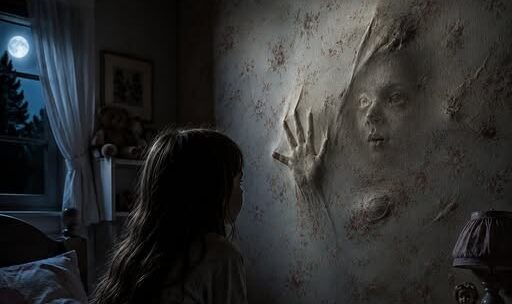
Every Night My Daughter Talked to Someone Through Her Bedroom Wall — The House Had No Neighbor on That Side
My daughter Emma was seven when the conversations began.
At first, I thought nothing of it.
Children talk to imaginary friends all the time.
My wife had died three years earlier, and Emma had spent much of that time inventing stories and characters.
So, when I heard her whispering through the baby monitor one night, I wasn’t concerned.
Until I realized she wasn’t talking to herself.
She was pausing.
Listening.
And answering.
One night, I asked her who she was talking to.
She smiled.
“The little girl.”
“What little girl?”
“The one in the wall.”
I laughed nervously.
“What wall?”
She pointed.
The wall beside her bed.
The same wall that faced the woods behind our house.
There wasn’t another room there.
No neighboring house.
No apartment.
Nothing.
Just insulation, drywall, and the forest.
I told myself it was imagination.
Kids say strange things.
Then Emma began telling me things she shouldn’t have known.
One morning she asked:
“Daddy, why did Mommy hide letters in the blue box?”
I froze.
My wife had hidden old letters in a blue box before she died.
Emma had never seen them.
I never told her about them.
When I asked where she heard that, she simply replied:
“The little girl told me.”
The next week I searched the attic.
The blue box was exactly where my wife had left it.
For the first time, I felt genuinely unsettled.
The conversations continued.
Every night.
Always after midnight.
One evening, I quietly stood outside Emma’s bedroom door.
I listened.
“Did it hurt?” Emma whispered.
Silence.
Then she nodded.
“Okay.”
Another pause.
Then:
“I’ll ask him.”
I opened the door immediately.
Emma jumped.
Her room was empty.
“Who are you talking to?”
“The little girl.”
“What did she say?”
Emma looked confused.
“She said she misses her dad.”
Something about the way she answered made my skin crawl.
A month later, I finally decided to inspect the wall.
I removed a section of drywall.
Nothing.
No hidden space.
No pipes.
No evidence of anything unusual.
Yet that night, Emma seemed excited.
“She’s happy now.”
“Who?”
“The little girl.”
“Why?”
“Because you looked for her.”
I barely slept.
Around 2 a.m., I heard scratching.
Slow.
Soft.
Coming from Emma’s room.
I grabbed a flashlight and rushed inside.
The scratching stopped immediately.
Then I noticed something on the wall.
A handprint.
Small.
Pressed beneath the wallpaper.
As though someone was trapped inside trying to push through.
I tore the wallpaper back.
There was nothing there.
No hand.
No cavity.
Just drywall.
The handprint vanished the next morning.
The following weekend, I visited the county records office.
The property records went back almost a century.
One file caught my attention.
In 1956, a young girl had disappeared from the land before our house was built.
Seven years old.
Never found.
Her bedroom had once stood approximately where Emma’s room now existed.
I didn’t tell Emma.
I didn’t tell anyone.
That night, she looked at me across the dinner table and asked:
“Did you find her?”
My fork slipped from my hand.
“Find who?”
“The little girl.”
I couldn’t answer.
Emma’s smile faded.
“She says you’re too late.”
A few days later, the conversations stopped.
Completely.
No whispers.
No voices.
Nothing.
For weeks, everything felt normal again.
Then one night, I woke to find Emma standing beside my bed.
She was holding a sheet of paper.
“Daddy?”
“What is it?”
“The little girl wanted me to give you this.”
My heart pounded.
I switched on the lamp.
The paper was old.
Yellowed.
Brittle.
As if it had been hidden for decades.
Written in a child’s handwriting were six words:
I FOUND MY DADDY. THANK YOU.
The note is still locked inside my desk.
I’ve had experts examine it.
The paper is old.
The handwriting is real.
No one can explain where it came from.
Emma is sixteen now.
She hasn’t spoken about the little girl in years.
But every once in a while, I catch her staring at that wall.
Listening.
As if someone is still speaking.
And sometimes…
I think she hears an answer.