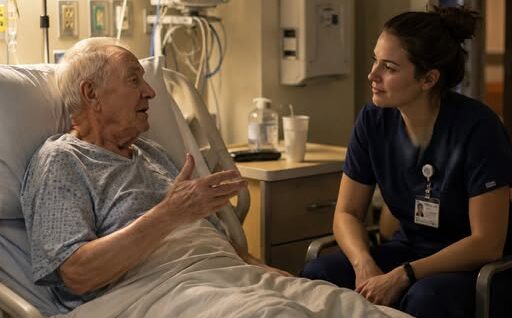
The Nurse Stayed with My Father Every Night — Even After Her Shift Ended
When my father was admitted to the hospital, nobody expected him to survive the month.
He was eighty-two.
His heart was failing.
His kidneys weren’t much better.
And after three separate hospitalizations in six months, even the doctors had started speaking in careful, measured sentences.
The kind that prepare families for bad news without saying it outright.
My sister and I took turns visiting.
Morning shifts.
Evening shifts.
Weekend shifts.
We did our best.
But life kept getting in the way.
Jobs.
Children.
Bills.
Responsibilities.
The hospital became a place we visited.
For one nurse, it seemed to become a place she refused to leave.
Her name was Sarah.
She worked nights.
At first, she seemed like any other nurse.
Professional.
Kind.
Patient.
But after a few weeks, something started to stand out.
Every morning when I arrived, Sarah was still there.
Her shift officially ended at 7:00 AM.
Yet I’d find her sitting beside my father’s bed at 7:30.
Sometimes 8:00.
Sometimes even later.
Talking with him.
Laughing with him.
Helping him eat breakfast.
I assumed she was simply finishing paperwork.
Then one morning I asked another nurse.
“Does Sarah always stay late?”
The nurse smiled.
“Pretty much.”
“Why?”
She shrugged.
“You’d have to ask her.”
The longer my father remained in the hospital, the closer they seemed to become.
Sarah knew his favorite baseball team.
His favorite songs.
His favorite desserts.
The two of them developed routines.
Morning coffee.
Crossword puzzles.
Card games.
Old stories.
Sometimes I’d walk in and find them laughing so hard my father could barely breathe.
I was grateful.
But I was also curious.
Something about it felt unusual.
One evening I arrived unexpectedly early.
Sarah’s shift had technically ended an hour before.
Yet there she was.
Sitting beside him.
Listening to a story I’d heard a hundred times.
When she noticed me, she immediately stood.
“I should let you have some family time.”
Before she could leave, I stopped her.
“You really don’t have to stay after work.”
She smiled.
“I know.”
Then she left.
The answer somehow created more questions than it solved.
A few days later, I finally asked my father.
“What’s the story with Sarah?”
He looked up from his crossword puzzle.
“What do you mean?”
“She spends more time here than some family members.”
He laughed.
“Maybe she likes my jokes.”
I rolled my eyes.
“Nobody likes your jokes.”
He grinned.
“She does.”
Then his expression softened.
“She’s a good person.”
That was all he’d say.
Months passed.
Against every expectation, my father stabilized.
He wasn’t getting better exactly.
But he wasn’t getting worse either.
Then one rainy Thursday afternoon, I arrived to find Sarah crying quietly in an empty hallway.
The sight shocked me.
She always seemed composed.
Unshakable.
I asked if she was okay.
She wiped her eyes quickly.
“Yeah.”
Clearly she wasn’t.
Before I could ask more, another nurse called her away.
The next morning, I discovered why.
My father was holding an old photograph.
One I’d never seen before.
It showed him standing beside a young woman in front of a hospital.
The woman couldn’t have been more than twenty.
“What is that?” I asked.
My father looked down at the picture.
Then toward the doorway.
Sarah had just entered the room.
For the first time since I’d met her, she looked nervous.
My father smiled.
“I suppose we should tell him.”
Tell me what?
Sarah sat down.
Neither spoke for several seconds.
Finally my father took a deep breath.
“Thirty-six years ago, I donated blood after a highway accident.”
I waited.
“So?”
“The blood saved someone’s life.”
I still didn’t understand.
Sarah’s eyes filled with tears.
“My mother.”
Everything suddenly became very quiet.
According to Sarah, her mother had suffered catastrophic injuries in a car crash.
The doctors desperately needed blood.
My father happened to be one of the donors who responded to an emergency appeal.
He never met the patient.
Never learned her name.
Never knew whether she survived.
Life moved on.
Decades passed.
Then one night, while reviewing patient records, Sarah recognized my father’s name.
She called her mother.
Her mother confirmed it.
The man lying in Room 412 was the stranger whose blood had saved her life.
The man whose decision had allowed her to grow up with a mother.
Allowed her mother to see grandchildren.
Allowed an entire future to exist.
Sarah looked down.
“I didn’t know how to tell him.”
Neither did I.
My father sat silently for several moments.
Then he asked the question none of us expected.
“Did your mother have a good life?”
Sarah nodded.
Through tears.
“Yes.”
My father smiled.
“Then it was worth it.”
Three months later, he passed away peacefully.
At the funeral, Sarah sat with our family.
Not because she was his nurse.
Because by then, she wasn’t.
She was someone whose life had been connected to his for nearly four decades.
Neither of them had known it.
Until the very end.