What If an Alien Invasion Didn’t Arrive in Spaceships?
When most people imagine an alien invasion, they picture enormous spacecraft appearing in the sky above major cities. Popular movies and television shows have conditioned us to expect fleets of advanced vessels, overwhelming technology, and a direct conflict between humanity and an extraterrestrial civilization.
But what if that assumption is completely wrong?
What if a truly advanced species would never send ships at all?
What if the most effective invasion wouldn’t look like an invasion?
According to a theory that has circulated online in various forms, an advanced civilization might spread across the galaxy using biology rather than spacecraft. Instead of transporting living beings through space, they could simply send the instructions for life itself.
The idea begins with a problem that any interstellar civilization would eventually face: distance.
Even if a civilization developed technology far beyond anything humanity currently possesses, the distances between stars remain almost unimaginable. Transporting living organisms across those vast stretches of space would require extraordinary amounts of energy, resources, and time. Entire generations could pass before a destination was reached.
From a practical perspective, sending adult organisms might be one of the least efficient methods possible.
But what if there were another option?
Instead of transporting soldiers, explorers, or colonists, an advanced civilization could theoretically send genetic information.
DNA.
Biological blueprints.
The fundamental instructions needed to create life.
These genetic packages could be placed inside asteroids, comets, meteorites, or specially designed objects capable of surviving the harsh conditions of space. Once launched, they could travel for thousands, millions, or even billions of years without requiring food, water, oxygen, or any form of maintenance.
Eventually, some of them might reach suitable worlds.
And that’s where the theory becomes unsettling.
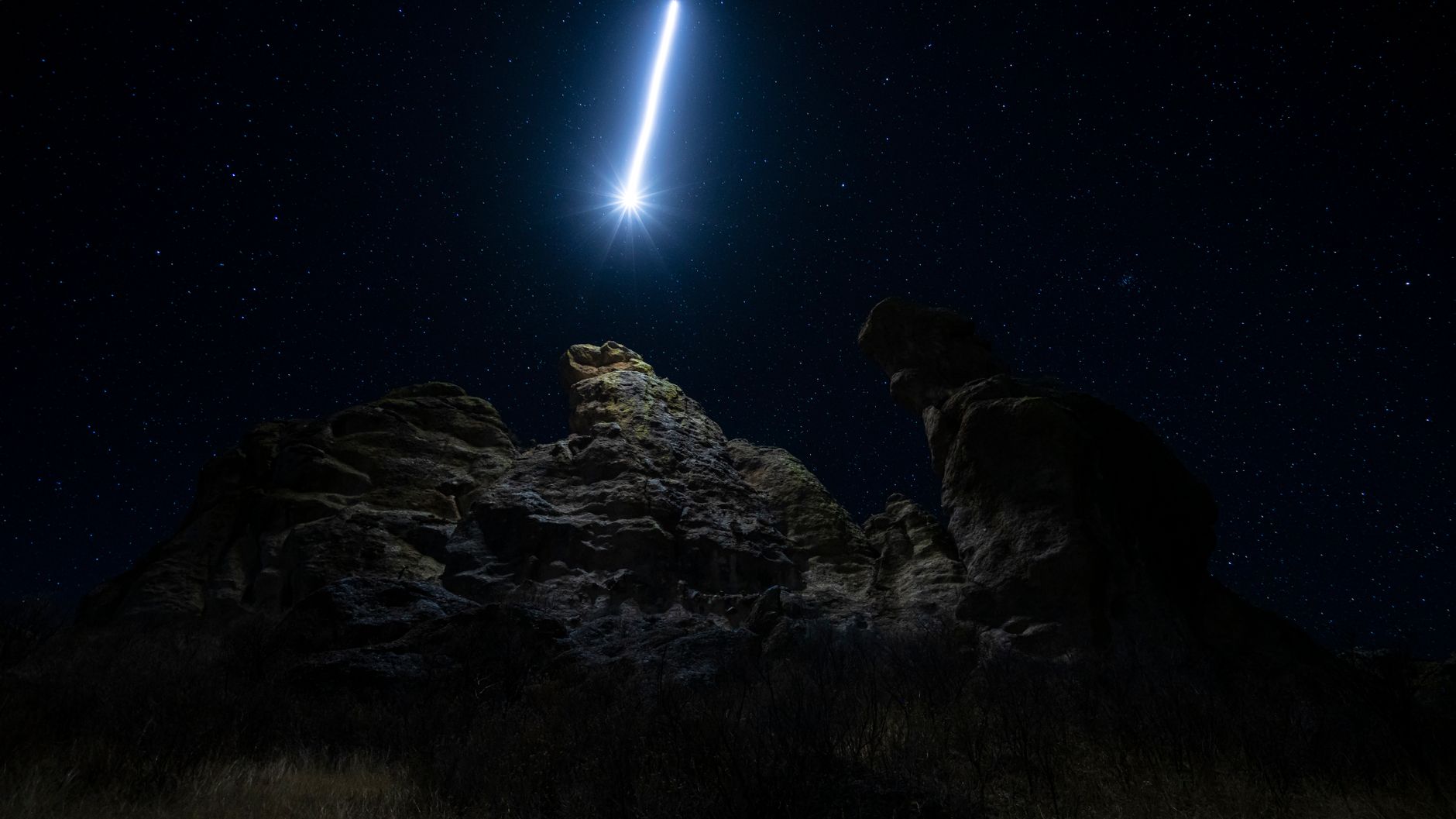
Imagine a meteorite crashing onto a distant planet.
To the inhabitants of that world, it would appear to be nothing more than a space rock. Perhaps scientists would study it. Perhaps nobody would pay attention to it at all.
Hidden within that object, however, could be dormant biological material.
Not fully developed organisms.
Not intelligent creatures.
Just the raw instructions necessary to create them.
Once exposed to the right environmental conditions, the material could theoretically begin to grow, replicate, and adapt.
At first the process might be invisible.
Microscopic.
Harmless.
But over time, those biological seeds could establish themselves within the ecosystem.
Unlike traditional invasion scenarios, there would be no dramatic arrival. No warning. No fleet appearing in orbit.
The invasion would already be underway before anyone realized it had begun.
Supporters of the theory often compare this process to agriculture.
When humans want to establish a forest, we do not transport mature trees across vast distances. We transport seeds.
The seed contains all the information necessary to create the tree later.
In the same way, an advanced civilization might choose to scatter biological seeds throughout the galaxy, allowing them to develop naturally wherever they land.
From that perspective, a meteorite carrying genetic material could function as a cosmic seed.
Some versions of the theory take the concept even further.
They suggest that the ultimate goal would not necessarily be exploration or colonization. Instead, it could be conquest.
According to this version, the organisms would be specifically engineered to dominate the target environment. They would arrive as simple biological forms and gradually evolve into something more complex over time.
The inhabitants of the planet would likely view them as native species because they would emerge within the ecosystem itself.
No one would see them arrive.
No one would witness an invasion force landing.
The process would be so gradual that it might be mistaken for natural evolution.
By the time the true purpose became apparent, it could be far too late to stop.
An interesting aspect of this theory is that it loosely resembles a real scientific hypothesis known as panspermia.
Panspermia proposes that the building blocks of life—or even simple microbial life—might travel between planets aboard meteorites and other celestial objects. Some scientists have explored whether life on Earth could have originated from material that arrived from elsewhere in space.
However, there is a major difference.
Panspermia is generally discussed as a natural process.
The invasion theory proposes intentional design.
Instead of life spreading accidentally, it suggests that a highly advanced civilization deliberately sends biological material across the galaxy with a specific purpose.
There is currently no credible evidence supporting such a scenario.
The theory remains speculative and belongs more to the realm of science fiction and thought experiments than established science.
Yet it continues to fascinate people because it challenges one of our basic assumptions.
Perhaps the most effective invasion would not involve weapons.
Perhaps it would not involve ships.
Perhaps it would not even involve aliens arriving in a form we could recognize.
Instead, it would arrive quietly.
Hidden within something as ordinary as a rock falling from the sky.
And by the time anyone understood what had happened, the invasion would already be generations old.