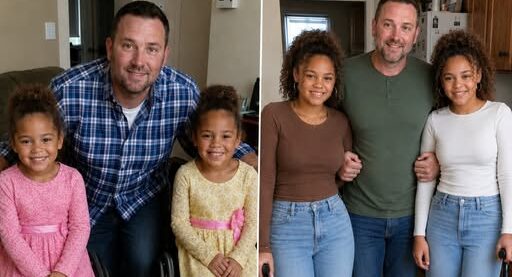
I Raised My Wheelchair-Bound Twin Daughters Alone After Their Mom Walked Out When They Were Six – On Father’s Day, 12 Years Later, They Said, ‘Dad, Please Don’t Be Mad, but We’ve Been Hiding Something from You’
I raised my twin daughters alone after their mother walked out when they were six. Hazel and Iris were born healthy, full of energy, always laughing, always competing over something small in the backseat after swim class the day everything changed. Their mother was driving when another car ran a red light. She walked away with bruises.
My daughters never walked again. Three weeks later, I came home from the hospital and found a note on the fridge that read, “I don’t want to spend the rest of my life pushing wheelchairs. Besides, you were the one who wanted kids.” That was the last I ever heard from her.
From that moment on, it was just the three of us, and I rebuilt my entire life around them. I learned how to braid hair at midnight from shaky YouTube videos after double shifts, worked two jobs that turned into three, and slowly sold everything I owned—our house, the car, even my father’s watch—to pay for therapy sessions insurance refused to fully cover.
I missed birthdays of my own just to make sure they never missed a single opportunity for theirs. Every dollar and every hour went toward one goal: getting my daughters back on their feet.
There were days it felt impossible. Hazel would cry until she fell asleep because she missed running, and Iris stopped speaking for weeks at a time, shutting the world out completely. But I never stopped showing up, even when it felt like nothing was changing. And then, five months ago, everything shifted.
At the clinic, Hazel gripped the parallel bars first, trembling as she took one step, then another. Iris followed right after, refusing to be left behind, both of them sobbing while I held their hands and cried harder than I ever had in my life. It wasn’t just progress—it felt like life returning to us in pieces.
This Father’s Day, they made breakfast like always, but something felt different. They kept exchanging glances, nervous and quiet in a way that didn’t match their usual energy.
After we sat down, Hazel finally reached across the table and took my hand, telling me not to be angry because they had been keeping a secret from me for years. Before I could even process that, the doorbell rang, and my chest tightened instantly because for a second, I thought it was their mother, somehow returning after all this time.
When I opened the door, it wasn’t her, but the sight still made my knees weaken. Standing there was the man from the clinic—the therapist who had guided my daughters through their hardest months—holding a red velvet box in his hands.
Behind me, I heard both girls stand up, and Hazel admitted softly that they had been planning this for months, waiting until they could stand on their own before telling me. Iris was already crying, not from fear but from excitement, and then the man spoke carefully, saying he loved my daughters and wanted my blessing.
For a moment, everything went silent inside me. It wasn’t anger or fear that hit first—it was the realization that the “secret” they had carried wasn’t something I needed to protect them from, but something they had built quietly together while I was still seeing them as the ones who needed saving.
I looked at Hazel and Iris standing there, no longer just my little girls but young women stepping into a life I had helped them reach, and I finally understood that I wasn’t losing them—I was being trusted to witness who they had become.