The 3:15 PM Routine: How an Adopted Stray’s Strange Habit Uncovered a Forgotten Sanctuary
Liam Harrison had always preferred the quiet predictability of his small suburban routine. As a high school history teacher in a sleepy town just outside the dense Maine wilderness, his days were structured by school bells, grading rubrics, and quiet evening walks. He lived alone in a modest house at the very edge of the neighborhood, where the paved roads gave way to thick timber.
The monotony of his autumn routine was broken on a damp Tuesday morning in September. A lone golden retriever was sitting perfectly still just outside his front gate, drenched from a midnight rain. The dog didn’t bark, whine, or approach the porch, but simply watched Liam leave for school with an unblinking, calm expression.
When Liam returned home late that afternoon, the animal was still standing in the exact same spot. Its coat was matted with burrs and mud, suggesting it had been wandering the wilderness for quite some time. Despite its ragged appearance, the dog possessed a strange, dignified patience that immediately struck a chord with the weary teacher.
Liam brought out a bowl of fresh water and a few leftover scraps of chicken from his dinner. The retriever approached slowly, maintaining a cautious but entirely gentle demeanor as it accepted the food. Over the next three weeks, this morning and evening feeding ritual became a permanent fixture of Liam’s daily schedule.
The dog never wandered off into the neighborhood, choosing instead to guard the perimeter of Liam’s small front yard. Realizing that no one in the local community forums was stepping forward to claim the animal, Liam took him to the vet. The checkup revealed the dog was remarkably healthy, microchipped with no active record, and roughly three years old.
With the paperwork finalized, Liam officially welcomed the gentle animal into his home and gave him the name Barnaby. Barnaby adjusted to indoor life with an uncanny ease, mastering basic house rules without a single day of formal training. Yet, beneath his perfectly calm exterior, a deeply ingrained biological clock was silently ticking away.
The strange behavior manifested on the first Monday of November, just as the winter chill began to settle over the town. At exactly 3:15 PM, while Liam was sitting at his kitchen table grading essays, Barnaby let out a sharp, anxious whine. The dog stood rigidly by the back door, his tail pointing straight out like a pointer tracking game in the brush.
Liam opened the door, assuming the dog simply needed a quick bathroom break in the fenced yard. Instead, Barnaby immediately bypassed the grass and leaped cleanly over the low wooden fence into the wild timber beyond. Fearing his new pet would get lost in the dense woods, Liam grabbed his jacket and rushed out after him.
Barnaby did not run aimlessly, but trotted with absolute purpose down a narrow, nearly invisible dirt path. The trail wound deep into an overgrown patch of forest that had been left untouched by developers for nearly a century. Liam struggled to keep pace as the dog navigated the thick brambles and fallen birch logs without a moment of hesitation.
The frantic chase ended abruptly in a secluded clearing dominated by a crumbling, forgotten stone foundation. Thick curtains of English ivy and wild moss completely choked the ancient masonry, hiding it from the casual hiker. It was obvious that a substantial structure had stood here long before the modern subdivision was built.
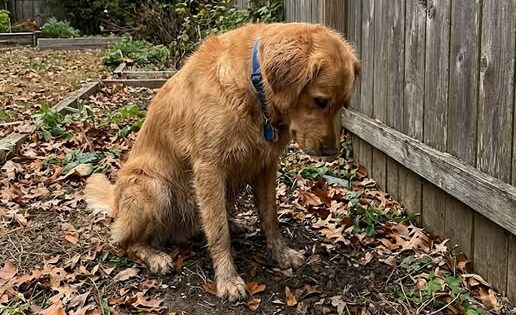
Barnaby marched directly into the center of the ruins, completely ignoring the scuttling wildlife and rustling leaves around him. He stopped at a completely featureless patch of damp earth surrounded by cracked stone blocks. Then, the dog sat down heavily, fixed his gaze entirely on the blank ground, and went dead silent.
Liam watched in utter bewilderment as his usually playful companion transformed into a living statue. For nearly an hour, no amount of calling, whistling, or clapping could break the dog’s intense, unyielding trance. Barnaby’s ears were perked forward, and his eyes remained locked onto the dirt as if waiting for a signal only he could hear.
As the minutes ticked by, the autumn shadows lengthened across the forest floor, casting eerie shapes through the trees. At exactly 4:15 PM, as if an invisible alarm had gone off, Barnaby suddenly relaxed his posture and let out a soft sigh. He trotted back over to Liam, wagging his tail happily, ready to head back to the warmth of the house.
This bizarre ritual repeated itself the next day, and every single day after that, with terrifying mathematical precision. Rain, snow, or biting wind could not deter Barnaby from demanding his 3:15 PM excursion into the dark woods. Liam tried using premium beef treats and his favorite squeaking tennis balls to disrupt the routine, but the dog ignored them entirely.
The teacher’s analytical mind began to obsess over the geographic meaning behind his dog’s daily afternoon trance. He knew the woods held centuries of local history, but the stone foundation was absent from all modern maps. Realizing he needed real answers, Liam took a personal day from school to visit the county’s historical library archives.
The county library was a quiet, musty building filled with rows of microform machines and bound local newspapers dating back to the 1800s. Liam spent hours scrolling through property records, tax maps, and municipal surveys of the forested borderlands. After a long and frustrating morning of dead ends, he requested the historical biographical files for the area.
The elderly archivist returned with a single, yellowed folder containing loose clippings from the winter of 1944. Liam carefully spread the fragile papers across the desk, his eyes scanning the faded columns for any mention of the woods. He finally struck gold in a December issue of the local gazette, which detailed the tragic passing of an enigmatic local resident.
The article explained that the stone ruins had once belonged to an elderly wilderness guide named Silas Thorne. Silas was a legendary tracker who had spent decades mapping the treacherous mountain passes and guiding lost travelers to safety. He lived a fiercely independent life in his hand-built cabin until a brutal blizzard claimed his life in late 1944.
According to the old reporter’s account, Silas had passed away quietly inside his cabin while a historic snowstorm raged outside. The article noted a heartbreaking detail: his remarkably loyal tracking dog had refused to leave the property after rescuers recovered the body. The animal had eventually vanished into the freezing wilderness, never to be seen by the townsfolk again.
Liam turned the fragile page over, and his heart skipped a beat as he stared at the accompanying photograph. It was a grainy, black-and-white portrait of Silas Thorne standing proudly in front of his wooden cabin. Standing right by his side was a large, powerfully built golden retriever looking up at him with devotion.
Liam pulled his smartphone out of his pocket to zoom in on the historical image with his camera flash turned off. On the dog’s left shoulder, clearly visible despite the grainy texture of the vintage print, was a distinct white marking. It was shaped exactly like a jagged lightning bolt, perfectly mirroring the unique coat pattern of Barnaby.
A profound sense of awe and historical curiosity washed over the young history teacher as he sat in the silent library. He realized that Barnaby wasn’t just a random stray, but a direct descendant of Silas Thorne’s legendary wartime companion. The generational instinct had somehow survived through decades of breeding, drawing the dog back to his ancestral home.
But the archival file contained one final, critical piece of information that explained the purpose behind the dog’s fixation. A handwritten journal entry from a neighboring farmer revealed that Silas had been working on a secret project during the final months of World War II. The guide had been quietly constructing a massive, heavily reinforced underground bunker directly beneath his home.
The secret shelter was designed to serve as a community sanctuary for local families in the event of wartime air raids or catastrophic blizzards. Because Silas passed away before he could formally reveal its completion to the town, the exact entrance to the vault was lost to time. Liam closed the folder, checked his watch, and realized it was already approaching 2:30 PM.
Liam drove home with his mind racing, his trunk packed with an assortment of heavy digging tools, flashlights, and a metal probe. He arrived just in time to see Barnaby pacing anxiously by the back door as the clock ticked closer to the fateful hour. At exactly 3:15 PM, the back door swung open, and the pair sprinted down the familiar dirt trail.
When they reached the ivy-covered stone foundation, Barnaby took his usual position in the exact center of the clearing. This time, however, Liam did not stand idly by watching his dog stare silently at the damp autumn earth. He stepped into the ruins with a heavy steel spade and began driving it deep into the compacted topsoil.
Barnaby did not bark or move away as the shovel sliced through thick tree roots and heavy layers of clay. Instead, the dog watched with an expression of intense anticipation, his tail giving a single, slow thump against the ground. Liam labored for thirty grueling minutes, pouring sweat despite the freezing afternoon air as he cleared away decades of forest debris.
Just as the clock crawled toward 3:45 PM, the tip of Liam’s steel shovel struck something incredibly solid with a loud, metallic ring. He dropped to his knees, frantically brushing away the loose dirt with his bare hands to reveal a flat surface. Beneath the mud lay a massive, reinforced iron hatch coated in a thick layer of protective red rust.
Using a heavy crowbar from his garage, Liam pried against the ancient locking mechanism until the corroded seal finally snapped open with a resounding crack. He lifted the heavy door, revealing a concrete staircase leading down into a perfectly dry, expansive subterranean room. He shone his flashlight into the darkness, illuminating rows of vintage wooden benches, hand-cranked air filters, and preserved emergency medical supplies.
The shelter was completely intact, a flawless historical time capsule from 1944 that had remained hidden from the world for over eighty years. Barnaby walked to the edge of the open hatch, peered down into his ancestor’s masterpiece, and let out a soft, contented whine. The dog’s ancient daily duty was finally fulfilled, and for the first time since his adoption, he turned away from the ruins before the hour was up.