I Gave a Free Dinner to An Old Man and His Tiny Dog — And by Morning, My Life Wasn’t the Same
My name is Laura. I’m forty-eight years old, and I own a tiny diner wedged between a pawn shop and a boarded-up laundromat in the heart of the city. The sign outside flickers on cold nights, and the booths squeak when customers slide in. Most days, the place smells like burnt coffee and nostalgia.
This diner was built by my grandfather. He opened it with his bare hands after the war, hammering nails late into the night, convinced that as long as people needed to eat, they’d need a place like this. When he passed, he left it to me — not because I was the most capable, but because I loved it the most.
Some days, I’m not sure love is enough.
My husband left five years ago, right after our daughter died. He said he couldn’t breathe in the house anymore. I didn’t stop him. I barely spoke. Grief hollowed me out, and the diner became the only thing keeping me upright.
Bills piled up. The bank started calling. Every morning, I unlocked the door wondering if it would be the day I finally gave up and sold the place my grandfather built.
That night was one of the coldest of the year. Snow pressed against the windows like a warning. I’d already turned the chairs upside down on two tables and was counting the register when the bell above the door rang.
My heart jumped.
“Please,” I whispered to no one, “let it be the buyer.”
But it wasn’t.
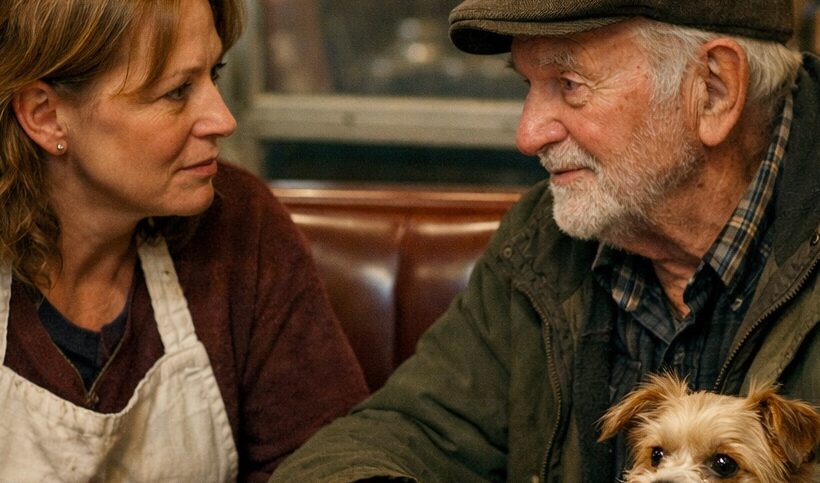
A frail old man stepped inside, leaning heavily on a crutch. His coat was thin, his hands red from the cold. And right behind him waddled the smallest dog I had ever seen — scruffy, alert, wearing a tiny green sweater that looked like it had been knitted with love and repaired with desperation.
The dog looked around like he owned the place.
“Evenin’, ma’am,” the man said softly. “What’s the cheapest thing on the menu?”
He stared up at the board, squinting, then down at the few coins resting in his palm. He counted them twice.
Something in my chest tightened.
I thought of my grandfather standing behind this very counter, wiping his hands on his apron.
We feed people, not wallets, he used to say.
“Why don’t you sit down?” I said, pulling out a booth. “I’ll make you something good.”
The man hesitated. “That’s too much. I don’t want to trouble you.”
“You’re not,” I said. And for the first time that day, I meant it.
I cooked like I was cooking for family. Pot roast, mashed potatoes, gravy made slow and thick. I even cut up a little plate of meat and set it down gently for the dog, who wagged his tail like he’d just won the lottery.
We ate together — three lost souls sharing one table.
His name was Walter. He didn’t say much about himself, but he listened when I spoke. Really listened. When I told him about my daughter, my voice cracked. I waited for the usual discomfort; the polite silence people offer when they don’t know what to say.
Instead, he reached across the table and said quietly, “I’m so sorry, sweetheart. You’ve been carrying all that alone, haven’t you?”
The words hit straight in my chest.
I nodded, unable to speak.
No one had called me sweetheart in years. No one had seen the weight I dragged behind me like a shadow.
When Walter finished eating, he tried to leave a few coins on the table. I slid them back into his hand.
“Come back anytime,” I said. “Both of you.”
He smiled — a small, grateful smile — and Pickles barked once, as if sealing a promise.
I watched Walter and Pickles disappear into the snow and told myself it was just one small kindness. Nothing more.
I was wrong.
The next morning, I arrived early to open the diner. The city was quiet, the sky still gray. As I reached for my keys, I froze.
There was a white envelope taped to the front door.
My name was written on it in shaky blue ink.
My keys slipped from my hand when I saw who it was from.
Inside the envelope was a simple note and a check.
The amount made my knees buckle.
Walter had passed away overnight.
The note explained everything — that Pickles was safe with a friend, that Walter had once owned several properties before life unraveled, and that he’d sold the last one recently. He wrote that he had no family left. He wrote that my kindness had reminded him of who he used to be.
You fed me when you didn’t have to, the note read.
You let me feel human again. Please accept this. It’s not charity. It’s gratitude.
I sat down right there on the diner steps and cried until the cold seeped into my bones.
That check saved my diner.
But more than that, it saved me.
I fixed the sign. Paid the bills. Kept my grandfather’s place alive.
And every morning, when I unlock the door, I set out a small bowl by the counter — just in case a tiny dog named Pickles ever walks back in, ready to remind me that sometimes, one free meal can change a life.
Sometimes, it changes yours.