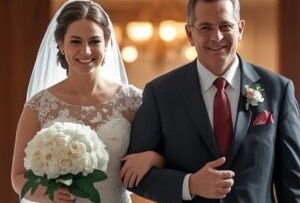
My Daughter Asked Me to Walk Her Down the Aisle with the Man Who Stole My Wife—And I Realized I’d Been Cast as the Villain
I never thought betrayal would echo this long.
When my wife left me for my best friend, Tom, it didn’t just end a marriage—it rewrote the map of my life. One day we were backyard barbecues and inside jokes, the next day he was standing in my kitchen, eyes down, saying it “just happened.” They married fast. Faster than healing ever could be.
Our daughter, Zoe, was young then. Too young to understand fault lines and fractures. She grew up in their house, with Tom helping with homework, teaching her how to drive, clapping loudest at school plays. By the time she was old enough to ask questions, the answers were already baked into her life. Tom wasn’t the man who betrayed her father. He was the man who showed up.
I learned to live with that. Learned to swallow the bitterness and smile when she talked about him. I told myself love wasn’t a competition. That there was room for all of us, even if the geometry hurt.
So, when Zoe called and said, voice trembling with excitement, “Dad, I want both of you to walk me down the aisle,” my chest locked up.
Both of you.
I pictured it instantly—my arm on one side, his on the other. The guests watching, some knowing the history, some not. A tidy picture of forgiveness that I hadn’t agreed to paint.
I told her no.
I didn’t raise my voice. I didn’t insult Tom. I just said, “I can’t do that. I won’t be a prop in someone else’s story.” The silence on the line afterward was thick. Hurt silence. The kind that stains.
The next morning, my phone exploded.
Cousins. Old family friends. Even my aunt, who never texts.
“Such a beautiful idea.”
“Proud of you for being the bigger man.”
“Peace looks good on your family.”
Confused, I asked what they were talking about.
That’s when I saw the invitation.
Cream cardstock. Elegant script. And right there, beneath the date and venue: Join us as we witness a touching family reunion and a meaningful moment of peace between the two most important men in Zoe’s life.
My hands shook. I read it three times, hoping I’d misunderstood.
Tom had “helped with the invitations.” Helped by turning my hesitation into a headline. By framing the entire moment as his noble attempt at unity—and my silent consent.
No one had asked me. Not Zoe. Not him. He’d just decided. Directed it like a scene he knew would play well.
And now I was trapped.
If I refused, I wouldn’t just be declining a walk—I’d be rejecting a public symbol of reconciliation. I’d be the man who couldn’t let go, who spoiled his daughter’s big day over “old wounds.” The whispers would follow me down every row.
Tom, meanwhile, would stand there calm and gracious, the man who “tried.”
Zoe would be crushed. Not because she wanted to hurt me, but because she believed peace could be scheduled, printed, and handed out like programs. She’s always believed that. That enough goodwill can fix anything.
I sat at my kitchen table staring at the invitation photo, feeling like my pain had been turned into décor.
The wedding is close now. Too close for clean solutions. Every option feels like loss. Either I swallow myself and give Tom a victory lap wrapped in forgiveness I don’t feel—or I stand my ground and risk becoming the villain in my daughter’s memory of her happiest day.
I love Zoe more than my pride. But I’m also tired of being erased politely.
I don’t know what the right move is anymore.
All I know is that walking away hurts. Walking beside him hurts too.
And for the first time in years, I feel like I’m back where it all started—standing still, while everyone else decides what my role is supposed to be.