Everyone In Death Valley Saw the Same Woman
The first time I heard about the woman, I laughed.
I was filming a documentary about disappearances in Death Valley.
The park receives millions of visitors every year, but every so often, someone vanishes.
Most are eventually found.
Some are found dead.
A few are never found at all.
As part of my research, I interviewed hikers, search-and-rescue volunteers, retired rangers, and local residents.
That’s when the stories started.
At first, they sounded like folklore.
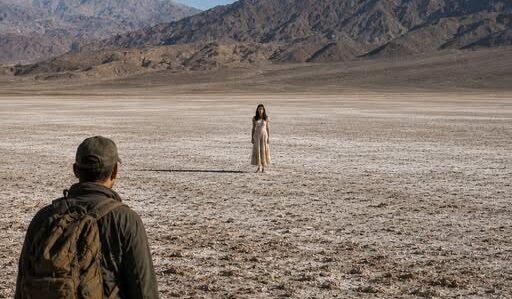
A woman in a pale dress.
Walking alone in the middle of nowhere.
No vehicle.
No backpack.
No water.
No protection from the heat.
Always alone.
Always heading deeper into the valley.
The descriptions were strangely consistent.
Different witnesses.
Different years.
Same woman.
The first ranger I interviewed rolled his eyes when I brought her up.
“People see all kinds of things out there,” he said.
“Heat does strange things.”
I agreed.
Mirages happen.
Dehydration affects perception.
There was nothing mysterious about that.
Then I found an incident report from 1998.
The report had never been made public.
Three hikers reported seeing a woman walking across a remote section of the valley.
They thought she was in trouble.
Temperatures were above 115 degrees.
Nobody should have been out there alone.
So they followed her.
Only one of the hikers returned.
According to his statement, the woman never acknowledged them.
Never turned around.
Never changed pace.
She simply continued walking.
Always just far enough ahead to remain visible.
After nearly an hour, she entered a narrow canyon.
The hikers followed.
When they emerged on the other side, she was gone.
Completely gone.
The survivor claimed they searched for her.
Instead, they found blood.
Fresh blood.
Not a few drops.
Smears.
Handprints.
Long streaks dragged across stone.
As if injured people had desperately tried to climb the canyon walls.
Then they found bones.
Not ancient bones.
Recent ones.
Human.
The report ended abruptly.
No explanation.
No photographs.
Just a note stating that the survivor refused further interviews.
I assumed the report was exaggerated.
Or incomplete.
Then I started finding similar accounts.
Again and again.
Different years.
Different locations.
Same woman.
Same pale dress.
Same impossible circumstances.
I became obsessed.
Three weeks later, I drove into Death Valley with two cameras, a drone, and enough supplies to stay for a week.
The first three days were uneventful.
Brutally hot.
But uneventful.
I filmed landscapes.
Interviewed visitors.
Captured drone footage.
Nothing unusual happened.
Then on the fourth afternoon, I saw her.
She was standing nearly half a mile away on a salt flat.
At first I thought she was another tourist.
Then I realized something.
There were no roads nearby.
No parking areas.
Nothing.
Just miles of open desert.
I lifted my camera.
Zoomed in.
My stomach tightened.
A woman.
Mid-thirties, perhaps.
Light-colored dress.
Long dark hair.
Standing completely still.
Watching me.
The moment I lowered the camera, she turned and walked away.
I told myself to forget it.
But that night, curiosity got the better of me.
I loaded the photographs onto my laptop.
The image was clear.
Too clear.
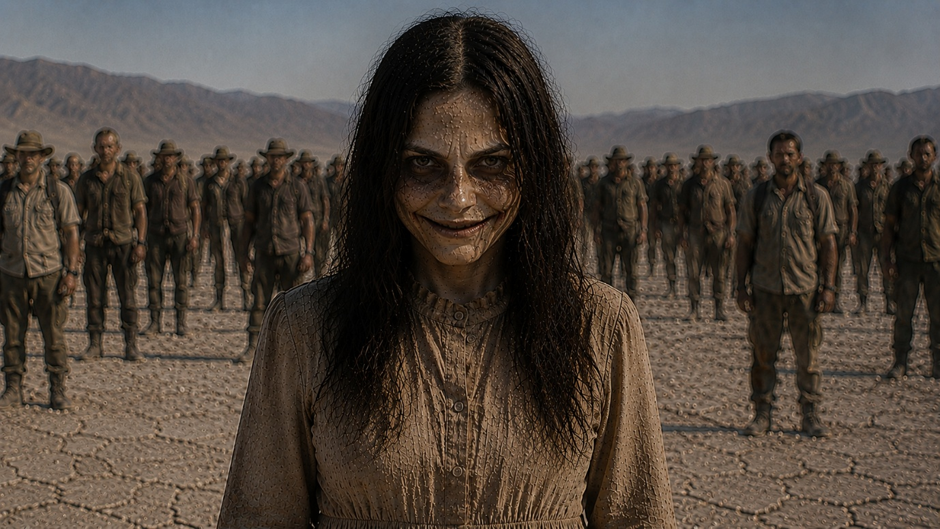
The woman’s face looked wrong.
Not distorted.
Not blurry.
Wrong.
The skin appeared cracked.
Like dried earth after a drought.
Tiny fractures running across her cheeks and forehead.
I zoomed in further.
Something dark filled the cracks.
Blood.
Dried blood.
I closed the image.
I didn’t sleep well that night.
The next morning, I stepped out of my tent and froze.
Footprints surrounded the campsite.
Bare footprints.
Hundreds of them.
They circled the tent repeatedly.
The sand was marked everywhere.
Yet none led toward the camp.
None led away.
They simply appeared around it.
As if someone had walked circles around me all night.
My first instinct was to leave.
Instead, I stayed.
That decision nearly got me killed.
Late that afternoon, I saw her again.
Closer this time.
Maybe fifty yards away.
Close enough to see details.
The dress wasn’t white.
It had once been white.
Now it was stained brown and red.
Sun-bleached.
Weathered.
Torn.
The skin on her arms looked split open.
Long cracks ran from wrist to shoulder.
Dark blood had dried inside them.
Yet she walked normally.
No limp.
No sign of pain.
No sign she even noticed.
Then she stopped.
And smiled.
I wish she hadn’t.
Because that’s when I saw her teeth.
Every gap between them was packed with sand.
Thick.
Dark.
As though her mouth had been filled with the desert itself.
I backed away.
She didn’t move.
Didn’t chase me.
Didn’t speak.
She simply watched.
I returned to camp and began packing immediately.
The sun was already dropping behind the mountains.
The shadows were stretching across the valley floor.
I threw equipment into the truck and left.
I drove for nearly two hours before stopping.
Only then did I start to calm down.
Only then did I convince myself I’d overreacted.
Until I reviewed the footage.
At first, everything looked normal.
Landscape shots.
Drone footage.
Time-lapses.
Then I found a sequence recorded on my second day.
Before I had ever seen the woman.
I froze the frame.
There she was.
Tiny.
Standing in the distance.
Watching.
Another clip.
There again.
Another.
Again.
Hundreds of images.
Hundreds.
She had been there the entire time.
I simply hadn’t noticed.
Then I reached the final drone footage.
Recorded only hours before I left.
I zoomed in.
And nearly dropped the laptop.
The woman wasn’t alone.
People stood behind her.
Dozens of them.
Men.
Women.
Children.
All motionless.
All staring directly upward at the drone.
Their skin looked burned.
Cracked.
Split open by heat.
Some were missing chunks of flesh.
Others appeared partially mummified by the desert air.
Every face carried the same expression.
Blank.
Empty.
Watching.
I wanted to believe they were rocks.
Shadows.
Anything else.
Then I noticed the clothing.
Backpacks.
Boots.
Hats.
Several matched photographs from missing-person reports I’d researched before the trip.
One belonged to a man who disappeared seven years earlier.
Another belonged to a college student who vanished in 2019.
The last one made my blood run cold.
The jacket belonged to a tourist reported missing only three weeks before I arrived.
I shut the laptop.
I never finished the documentary.
Never returned to Death Valley.
Never spoke publicly about what I found.
But every now and then, I make the mistake of looking at those photographs again.
And every time I do, I notice something new.
Something I somehow missed before.
The people behind her aren’t looking at the drone.
They aren’t looking at the camera.
They’re looking directly at me.
And the woman?
She’s smiling.