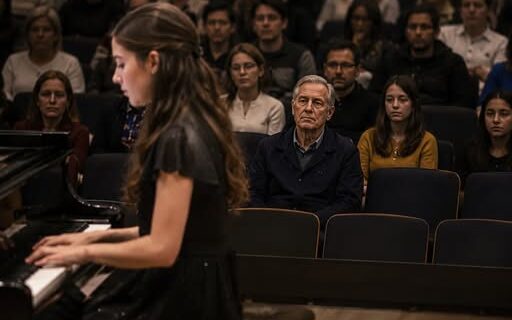
My Daughter Asked Why the Same Man Attended Every One of Her Recitals
The first time my daughter mentioned him, she was nine years old.
We were driving home from her spring piano recital when she asked:
“Dad, who’s the man in the third row?”
I glanced at her in the rearview mirror.
“What man?”
“The one who’s always there.”
I assumed she meant another parent.
I told her I didn’t know and thought nothing of it.
Three months later, after her summer recital, she asked again.
“Did you see him this time?”
“See who?”
“The same man.”
This time I looked.
An older man sat alone in the third row.
Gray hair.
Navy jacket.
Hands folded in his lap.
Nothing remarkable.
When the performance ended, he stood, smiled toward the stage, and left.
Alone.
No flowers.
No family.
No child performing.
Just gone.
Over the next few years, my daughter continued mentioning him.
Every recital.
Every school concert.
Every talent show.
Always the same seat.
Always alone.
Always leaving immediately afterward.
Eventually, I started looking for him too.
And every single time, there he was.
By the time my daughter turned thirteen, even her music teacher knew who we meant.
Nobody knew his name.
Nobody knew why he came.
Yet he never missed a performance.
Not one.
Then one rainy November evening, I finally decided to follow him.
The concert ended.
Parents crowded the lobby.
Students posed for photographs.
The old man headed toward the parking lot.
I hurried after him.
“Excuse me.”
He stopped immediately.
The expression on his face told me he’d been expecting this conversation for years.
“Can I help you?” he asked quietly.
I pointed toward the auditorium.
“My daughter noticed you’ve attended every one of her recitals.”
The color drained from his face.
For several seconds, neither of us spoke.
Then he nodded.
“She’s gotten very good.”
I wasn’t sure how to respond.
“Do you know her?”
His eyes filled with tears.
And for the first time, I saw pain behind the calm expression he always wore.
“I knew her mother.”
My stomach tightened.
My wife had died from cancer when our daughter was four.
Fast.
Unexpected.
Brutal.
The old man immediately noticed my reaction.
“Not like that,” he said softly.
“We were friends.”
He looked down at the wet pavement.
“The best kind.”
Then he told me a story I’d never heard.
Years before I met my wife, she volunteered at a community center.
The old man had been a struggling single father raising a daughter with severe health problems.
His daughter spent much of her childhood in hospitals.
Doctors.
Surgeries.
Treatments.
Endless uncertainty.
Many people promised to help.
Most disappeared.
My wife didn’t.
She drove them to appointments.
Sat through surgeries.
Helped with medical bills.
Watched his daughter when he worked.
According to him, she became family.
Then his daughter died.
She was only nine years old.
The old man reached into his wallet and showed me a photograph.
A little girl holding a violin.
Smiling.
For a moment, I forgot how to breathe.
She looked remarkably like my daughter.
The same eyes.
The same smile.
The same stubborn expression.
“My daughter loved music,” he said.
“She wanted to perform more than anything.”
His voice broke.
“But she never got the chance.”
Rain continued falling around us.
Neither of us moved.
Then he told me the part that changed everything.
When my wife became pregnant, she shared the news with him.
They remained close friends.
One day she made him promise something.
“If anything ever happens to me,” she told him, “keep an eye on her.”
The old man swallowed hard.
“I thought she was being dramatic.”
His eyes filled again.
“Then she got sick.”
For years after my wife’s death, he’d quietly kept that promise.
Never introducing himself.
Never interfering.
Never inserting himself into our lives.
Just watching from a distance.
Making sure my daughter was okay.
Making sure she kept playing.
Making sure she kept smiling.
The way his daughter never got the chance to.
Then he reached into his coat pocket.
Inside was a sealed envelope.
My wife’s handwriting covered the front.
To My Daughter.
My hands started shaking.
“I’ve carried this for fourteen years,” he said.
“I always thought there would be a right time.”
I stared at the envelope.
Unable to speak.
Unable to think.
That night, my daughter and I sat together on the living room couch.
And for the first time since her mother died, she received a letter written directly to her.
The old man never attended another recital.
Six months later, I learned he had passed away.
But every time my daughter performs, she still looks toward the third row before she walks on stage.
And every time she does, I do too.