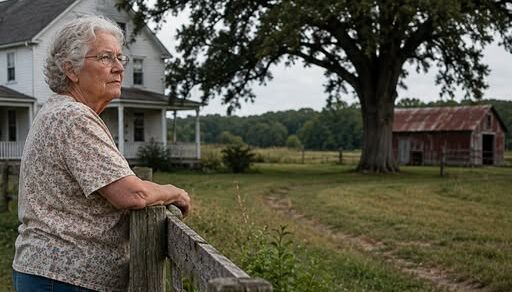
My Grandmother Refused to Sell Her Farm — After She Died, I Learned Why
My grandmother spent fifty-seven years on the same farm.
Everyone in town knew her.
Everyone respected her.
And everyone thought she was making a mistake.
Developers had been trying to buy her land for years.
The offers started small.
Then they became ridiculous.
Hundreds of thousands of dollars.
Then over a million.
Eventually, people stopped asking whether she would sell.
They started asking why she wouldn’t.
The farm barely made money anymore.
Most of the fields sat unused.
The barn needed repairs.
The house was falling apart.
My grandmother lived alone.
Yet every time a new offer arrived, she rejected it without even reading the details.
The answer was always the same.
“No.”
That single word drove everyone crazy.
My father argued with her.
My uncles argued with her.
Even I tried once.
“Grandma, why keep holding onto this place?”
She looked across the fields.
“Because it isn’t mine.”
I laughed.
The farm had been in our family for generations.
Of course it was hers.
But she never explained further.
As the years passed, the pressure grew.
Developers purchased neighboring properties.
New roads appeared.
Housing projects moved closer.
The farm became an island surrounded by progress.
Still she refused.
Then she died.
Ninety-one years old.
Peacefully.
The funeral was small.
Family.
Friends.
Neighbors.
People shared stories.
Laughed.
Cried.
Remembered.
Afterward, we gathered at the farmhouse to discuss the estate.
Everyone assumed the land would finally be sold.
The paperwork seemed inevitable.
Then the attorney opened a sealed envelope.
My grandmother had left specific instructions.
Before any sale could occur, one person had to be shown something.
Me.
Nobody understood why.
I certainly didn’t.
The next morning, the attorney handed me an old key.
Rusty.
Heavy.
Ancient.
Attached was a handwritten note.
“The oak tree.”
I immediately knew which one she meant.
A massive oak stood near the edge of the property.
Older than anyone alive.
My grandmother visited it almost every day.
I thought it was sentimental.
Nothing more.
The key led to a small metal box buried beneath the tree.
Inside were photographs.
Letters.
Maps.
And one leather journal.
The journal belonged to my great-grandfather.
What I read over the next several hours changed everything.
During the Great Depression, dozens of families in the area lost their homes.
Banks foreclosed.
Farmers went bankrupt.
Entire families disappeared overnight.
According to the journal, my great-grandfather secretly allowed several families to live on parts of the property.
No rent.
No contracts.
No publicity.
Just help.
Some stayed months.
Some stayed years.
Many eventually rebuilt their lives and moved on.
The journal contained names.
Dozens of them.
People nobody in town remembered anymore.
Then I reached the final pages.
That’s when I discovered the real secret.
Several acres of the farm weren’t legally ours at all.
My great-grandfather had promised those families something.
As long as a member of our family owned the land, nobody would ever be forced from it again.
The promise had never been written into law.
It existed only in his journal.
And in my grandmother’s memory.
At first, it sounded absurd.
Then I examined the maps.
Small homes.
Hidden access roads.
Remote sections of property.
Places I had never visited.
The following week, I explored them.
What I found stunned me.
People were still living there.
Not many.
Just a handful.
An elderly widow.
A retired mechanic.
A disabled veteran.
A woman raising two grandchildren.
All quietly occupying forgotten corners of the property.
Most had nowhere else to go.
Most paid nothing.
And every one of them believed the same thing.
The family would never abandon them.
My grandmother had kept that promise for decades.
Paying taxes.
Maintaining roads.
Fixing roofs.
Helping whenever she could.
Without telling anyone.
Without seeking recognition.
Without ever explaining herself.
Suddenly her refusal to sell made perfect sense.
The developers weren’t buying farmland.
They were buying people out of existence.
The next family meeting was tense.
Everyone wanted answers.
Everyone wanted money.
I placed the journal on the table.
Then I told them what my grandmother had spent fifty years protecting.
The room fell silent.
Some relatives changed their minds immediately.
Others didn’t.
Arguments followed.
Weeks passed.
Then months.
In the end, we reached a decision.
The farm would never be sold.
Instead, we created a trust to preserve the land and continue the promise.
Sometimes people ask why.
Why hold onto aging farmland worth millions?
Why refuse life-changing money?
I always give them the same answer my grandmother gave me.
Because it was never ours to sell.