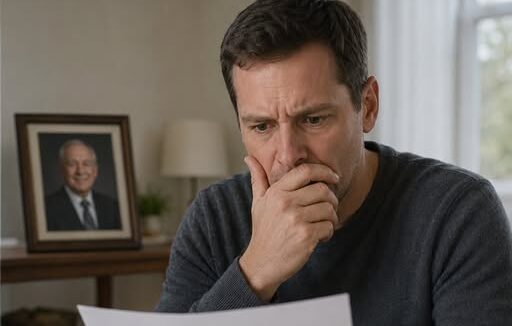
My Father Left Everything to My Sister — I Thought I Knew Why
When my father died, I thought I knew exactly where I stood in his life.
I was wrong.
The funeral was held on a cold Thursday morning. Friends, relatives, former employees, and neighbors filled the church. My father had spent nearly forty years building a small manufacturing business from the ground up, and over the years he had become one of those people everyone seemed to know.
As people shared stories about him, I felt proud.
Not just because he was my father.
Because I had spent most of my adult life working beside him.
I knew every machine in the workshop.
Every customer.
Every supplier.
Every challenge the business had faced.
For more than thirty years, I had been there.
That was why the reading of the will hit me so hard.
My sister, Emily, received the family home.
She received the land.
She received the business.
She received virtually every significant asset my father owned.
I received his watch.
At first, I thought I had misunderstood.
I sat there waiting for the lawyer to continue.
Surely there was another page.
Another document.
Another explanation.
There wasn’t.
The meeting ended.
Everyone stood.
Nobody knew what to say.
Emily looked almost as shocked as I was.
“I didn’t know,” she whispered.
I nodded, but I barely heard her.
All I could think was that somehow, after everything we had built together, my father had decided I wasn’t worthy of the legacy.
The months that followed were difficult.
People tried to be supportive.
Some suggested there must have been a mistake.
Others hinted that maybe my father had reasons nobody understood.
Those comments only made things worse.
Because I couldn’t stop asking myself the same question:
What had I done wrong?
I replayed years of memories in my head.
The arguments we’d had.
The times I’d disagreed with him.
The business decisions he hadn’t liked.
The opportunities I had passed up.
Slowly, I began rewriting my own history.
Every disagreement became evidence.
Every criticism became proof.
The more I thought about it, the more convinced I became that my father had quietly lost faith in me long before he died.
My relationship with Emily suffered too.
Not because she had done anything wrong.
Because every time I looked at her, I was reminded of the will.
She never bragged.
Never acted entitled.
In fact, she repeatedly offered to share parts of the inheritance.
I refused every time.
I didn’t want charity.
I wanted understanding.
Years passed.
Life moved on.
I focused on my own work and rarely spoke about my father anymore.
The anger slowly faded, but the hurt never completely disappeared.
Then, almost six years after his death, Emily called me unexpectedly.
Her voice sounded strange.
Nervous.
“Can you come over?” she asked.
“I found something.”
An hour later, I was sitting at her kitchen table.
In front of her was a sealed envelope.
The paper had yellowed with age.
My name was written across the front in my father’s handwriting.
I recognized it immediately.
My heart started racing.
“Where did you find it?” I asked.
“It was hidden behind a drawer in his old desk.”
For a moment neither of us moved.
Then I opened it.
Inside was a handwritten letter.
The first line stopped me cold.
“If you are reading this, then I am no longer here to explain the decision I made.”
I continued reading.
My father explained that years earlier, when the business had nearly failed during a recession, he had become obsessed with protecting the family from financial disaster.
At the same time, I had been launching my own company.
I remembered those years well.
I had borrowed heavily.
Taken risks.
Worked endless hours trying to make something of my own.
According to the letter, my father had worried constantly that if my company collapsed, creditors could come after assets connected to my name.
He feared everything he had spent decades building could be lost.
So he quietly transferred ownership structures and future inheritance plans into Emily’s name.
Not because he loved her more.
Because he trusted her to protect the family.
I looked up from the letter.
Emily was crying.
“You knew?” I asked.
She nodded.
“He made me promise.”
I stared at her.
“For six years?”
She nodded again.
“I gave him my word.”
I returned to the letter.
The next pages described conversations I never knew had happened.
My father wrote about how Emily had agreed to carry the burden.
How she had accepted years of misunderstanding without defending herself.
How she had protected a promise even when it damaged her relationship with me.
Then I reached the final page.
The handwriting was shakier.
The words were shorter.
I knew he must have written it near the end of his life.
The final paragraph read:
“You think I left everything to your sister.
The truth is that I left different things to each of you.
I left the business to Emily because she loves caring for people.
I left the house to Emily because she could never imagine selling it.
I left the land to Emily because she wanted future generations to have it.
The thing I valued most was never any of those things.
The thing I valued most was the character you built when nobody was watching.
That was always yours.
Nobody could inherit it because nobody could take it from you.”
I stopped reading.
For several minutes, neither of us spoke.
Then Emily reached into another folder and handed me a photograph.
It showed my father and me standing in front of the first workshop we had ever owned.
The building was tiny.
The roof leaked.
The equipment was old.
But we were both smiling.
On the back, my father had written a single sentence.
“Thank you for helping me build a life worth leaving behind.”
For years, I thought the will had been my father’s final judgment of me.
I believed it was proof that I had somehow disappointed him.
Instead, the truth was almost the opposite.
The greatest mistake wasn’t the will.
It was assuming I understood what my father valued most.
And after all those years, one letter finally gave me something I thought I would never receive:
Peace.