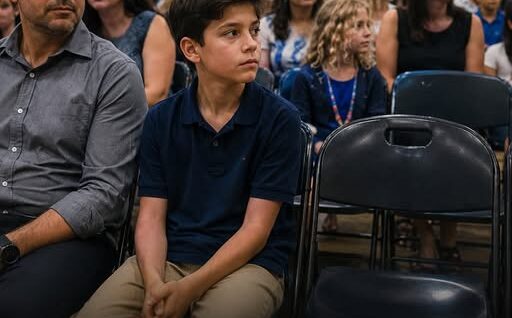
My Son Kept Leaving One Seat Empty at Every School Event — I Finally Learned Why
My wife, Sarah, passed away when our son, Ethan, was six years old.
One day she was helping him with his homework at the kitchen table.
Three weeks later, she was gone.
People often talk about grief as if it arrives all at once.
In my experience, it arrived in pieces.
The empty side of the bed.
The extra toothbrush.
The silence during dinner.
The first birthday without her.
The first Christmas.
The first Mother’s Day.
Each one hurt differently.
What worried me most, however, wasn’t myself.
It was Ethan.
For months after Sarah died, he barely spoke about her.
He cried sometimes.
Asked questions occasionally.
But mostly he kept his feelings to himself.
I constantly wondered whether that was healthy.
Whether he was coping.
Or simply hiding his pain.
A few months later, Ethan had his first school concert.
Parents filled the auditorium.
Children sat in neat rows on the stage.
As I walked toward our seats, Ethan suddenly stopped me.
“Not that one,” he said.
“What do you mean?”
He pointed to the chair beside me.
“Leave that one empty.”
I looked around.
The room was crowded.
Parents were searching desperately for available seats.
“Why?”
He shrugged.
“That’s Mom’s seat.”
For a moment, I didn’t know what to say.
Then I nodded.
“Okay.”
So we left it empty.
The concert ended.
Life moved on.
I assumed it was a one-time thing.
It wasn’t.
The following year, Ethan received an academic award.
Again, he insisted on leaving an empty chair beside us.
When I suggested another parent could use it, he shook his head.
“That’s Mom’s seat.”
The same thing happened at his soccer matches.
Birthday dinners.
School plays.
Graduation ceremonies.
There was always an empty seat.
Always the one beside him.
Always reserved for someone who could never sit there.
At first, friends and relatives found it touching.
Then they found it strange.
A few even suggested I should discourage it.
“He’s holding on too tightly,” one relative told me.
“He needs to move forward.”
Maybe they were right.
I didn’t know.
Parenting doesn’t come with instructions.
Especially not after loss.
One evening, when Ethan was twelve, I finally asked him about it.
We were sitting on the porch watching a thunderstorm.
“Do you really think Mom is sitting in that chair?”
He looked surprised.
“No.”
“Then why leave it empty?”
He thought for a moment.
Then simply said:
“Because it’s hers.”
That was the end of the conversation.
Years passed.
Ethan grew taller.
His voice changed.
He started driving.
Applying for colleges.
Building a life of his own.
Yet the chair remained.
At every important event, there was always one empty seat.
People stopped asking questions.
It simply became part of who he was.
When Ethan graduated from high school, thousands of people packed the stadium.
Families filled entire rows.
As I searched for our seats, I noticed something.
Sure enough, Ethan had left one chair empty.
The person sitting behind us politely asked whether someone was coming.
Before I could answer, Ethan smiled.
“Not today.”
The woman looked confused.
I understood exactly what he meant.
The chair remained empty throughout the ceremony.
I remember looking at it several times.
Part of me felt proud.
Part of me felt sad.
Part of me wondered if Sarah would have loved or hated the tradition.
Probably both.
A few months later, Ethan was accepted into a university several states away.
The night before he left, we began packing boxes.
Clothes.
Books.
Old trophies.
School projects.
Years of memories.
While sorting through a shelf in his room, I found a worn notebook.
At first I assumed it contained class notes.
Then I noticed something written on the cover.
For Mom.
I immediately closed it.
It felt private.
But later that night, Ethan noticed it on my desk.
Instead of taking it back, he handed it to me.
“You can read it now.”
I hesitated.
“Are you sure?”
He nodded.
So I opened it.
The first entry had been written shortly after Sarah died.
The handwriting was messy and uneven.
It read:
Hi Mom.
Dad cried again today.
I pretended not to see.
I miss you.
The next letter was written several months later.
Then another.
And another.
Year after year.
Every birthday.
Every Christmas.
Every important event.
Ethan had written letters to his mother.
Hundreds of pages.
He told her about school.
Friends.
His fears.
His achievements.
The girls he liked.
The colleges he applied to.
Everything.
As I read, tears blurred the words.
I wasn’t just reading a notebook.
I was reading my son’s childhood.
A childhood he had shared with someone who wasn’t there.
Then I reached the final letter.
The one he had written just before leaving for college.
The handwriting was mature now.
Confident.
Adult.
The letter ended with words I’ll never forget.
It said:
Dad still leaves your chair empty.
People think it’s because I can’t let go.
They’re wrong.
I know you’re not coming.
I figured that out a long time ago.
I leave the chair empty because I never wanted you to think we forgot you.
If you could somehow see us, I wanted you to know there would always be a place for you.
Even if nobody else could see it.
I sat there staring at the page.
For years I thought the empty chair was a sign that my son couldn’t move on.
Instead, it was a sign that he had.
He wasn’t waiting for his mother to return.
He wasn’t trapped in grief.
He was honoring love.
There is a difference.
The next morning, I drove Ethan to college.
Before he got out of the car, he looked at me and smiled.
“You know,” he said, “you don’t have to leave the chair empty anymore.”
I smiled back.
“Maybe not.”
Then I paused.
“But I think I want to.”
For the first time in years, neither of us felt sad.
Because we finally understood something.
The chair had never been empty at all.